The Machine That Changed Everything
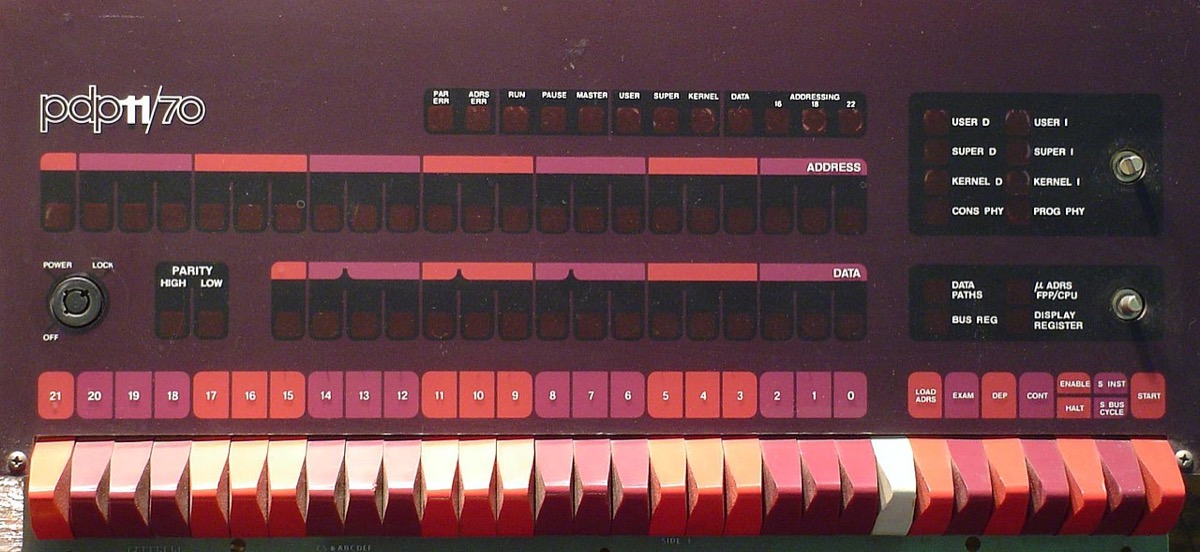
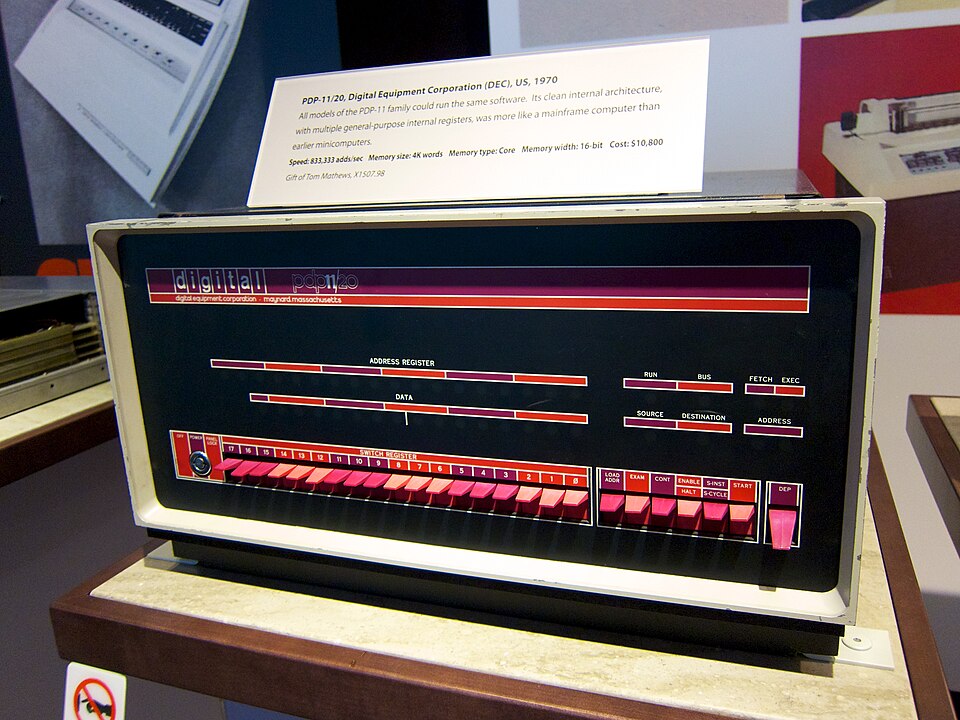
Announced in January 1970 and first shipped that spring, the PDP-11 was born in the laboratories of Digital Equipment Corporation in Maynard, Massachusetts. The project was initiated in late 1968 by Gordon Bell, DEC's Vice President of Engineering, with Harold McFarland appointed as chief architect. McFarland, a former student of Bell's at Carnegie Mellon University, brought a 16-bit design from his research that became the foundation of the PDP-11 architecture.
Its orthogonal instruction set, the revolutionary UNIBUS, and its elegant register architecture immediately captivated engineers worldwide. By 1980, the PDP-11 had become the best-selling computer in the world. DEC sold over 170,000 PDP-11s during the 1970s alone, and approximately 600,000 units over the product line's entire lifetime.
More than just a computer, the PDP-11 was the machine on which UNIX was developed, the platform that motivated the creation of the C programming language, and the catalyst for a computing revolution that still shapes our world today.
The PDP-11 was not just a product of engineering — it was the creation of visionary individuals whose decisions shaped the future of computing.
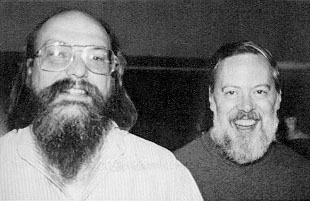

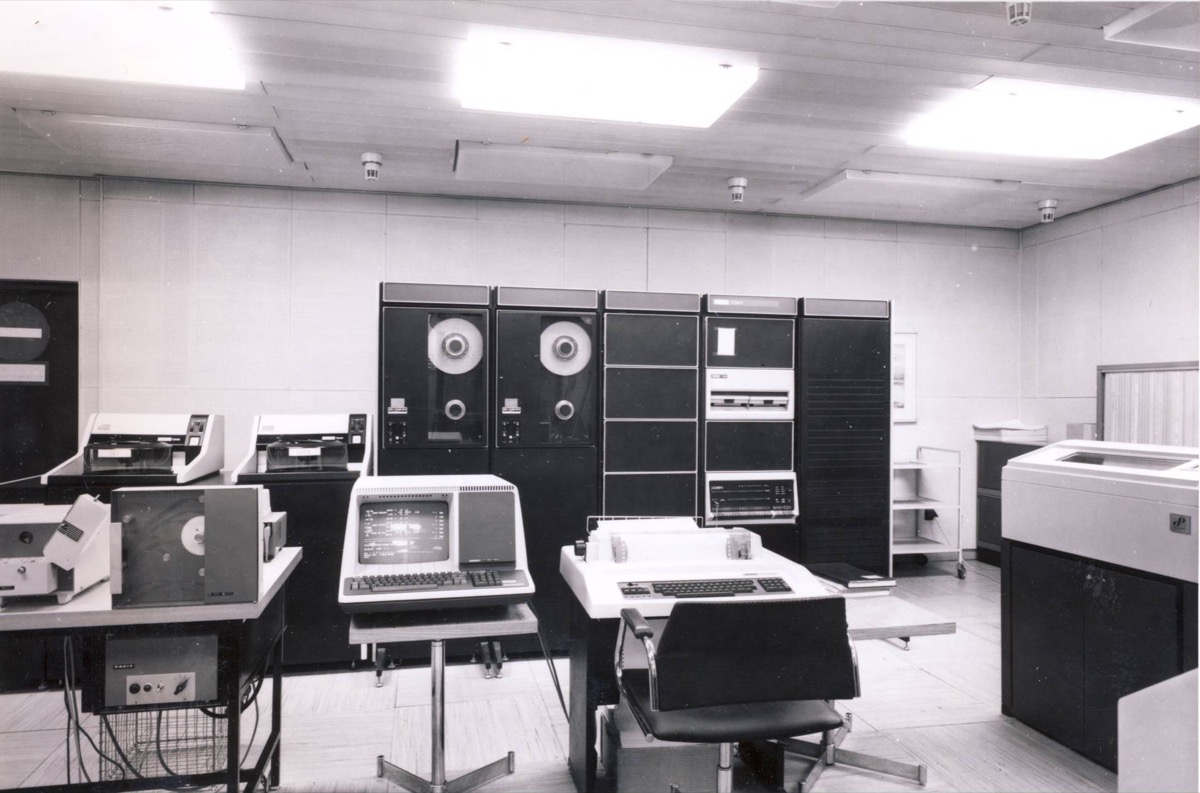
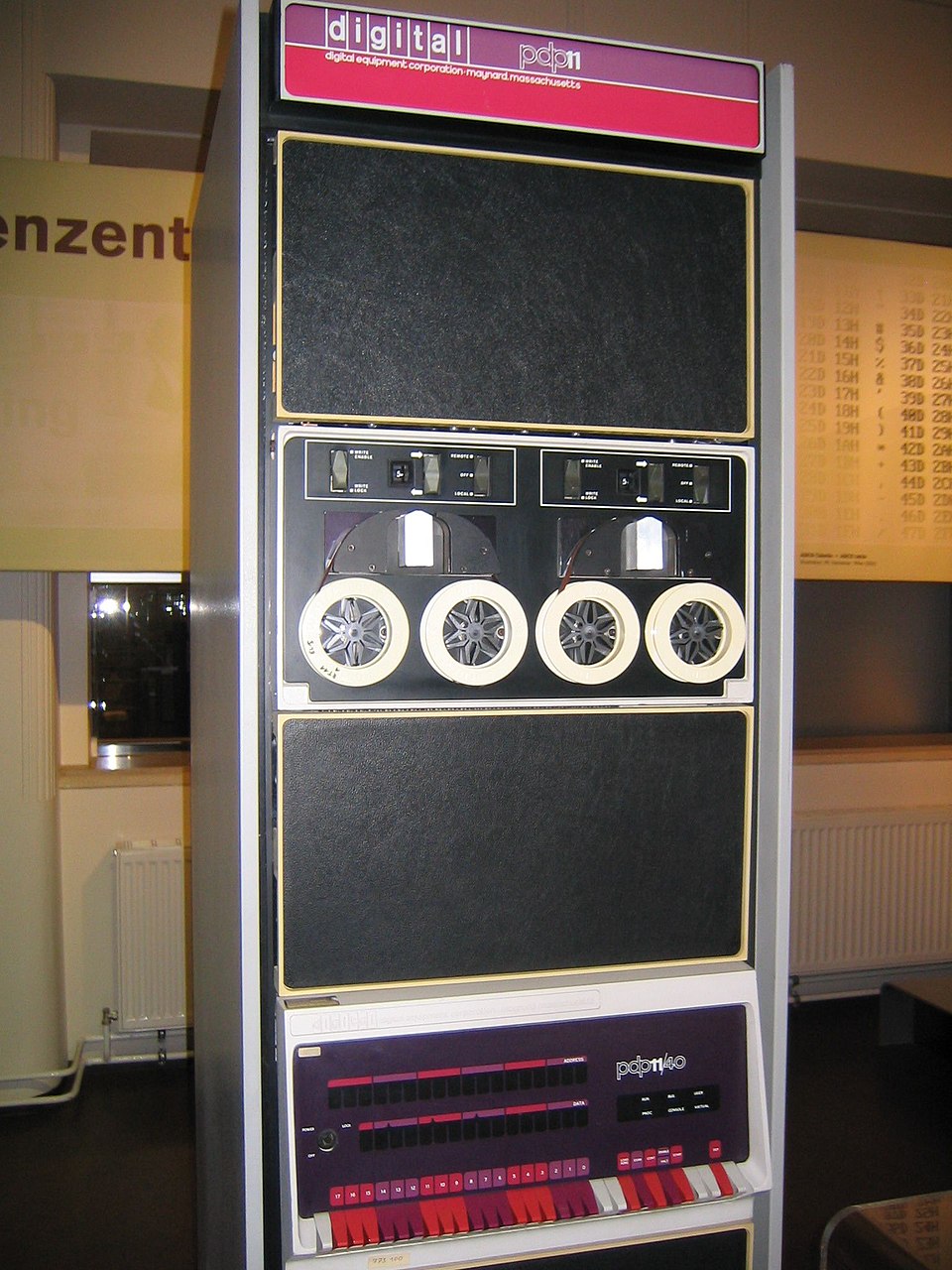
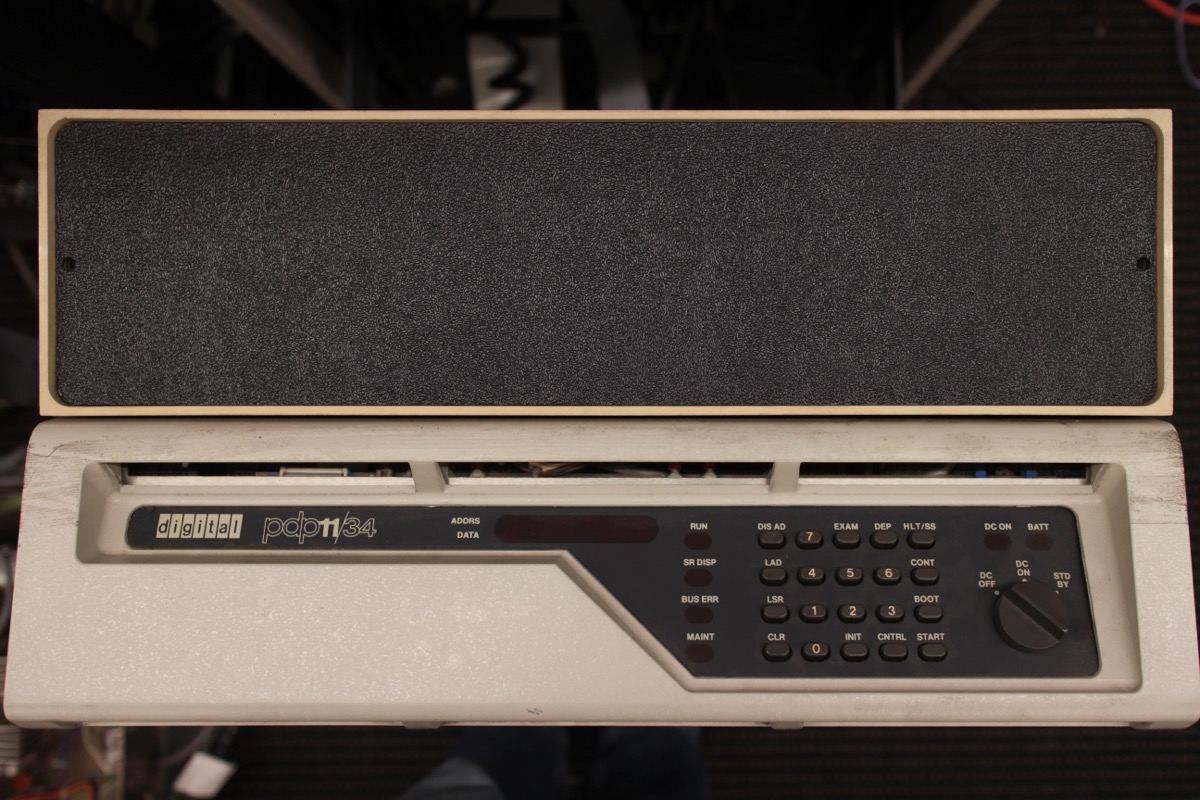
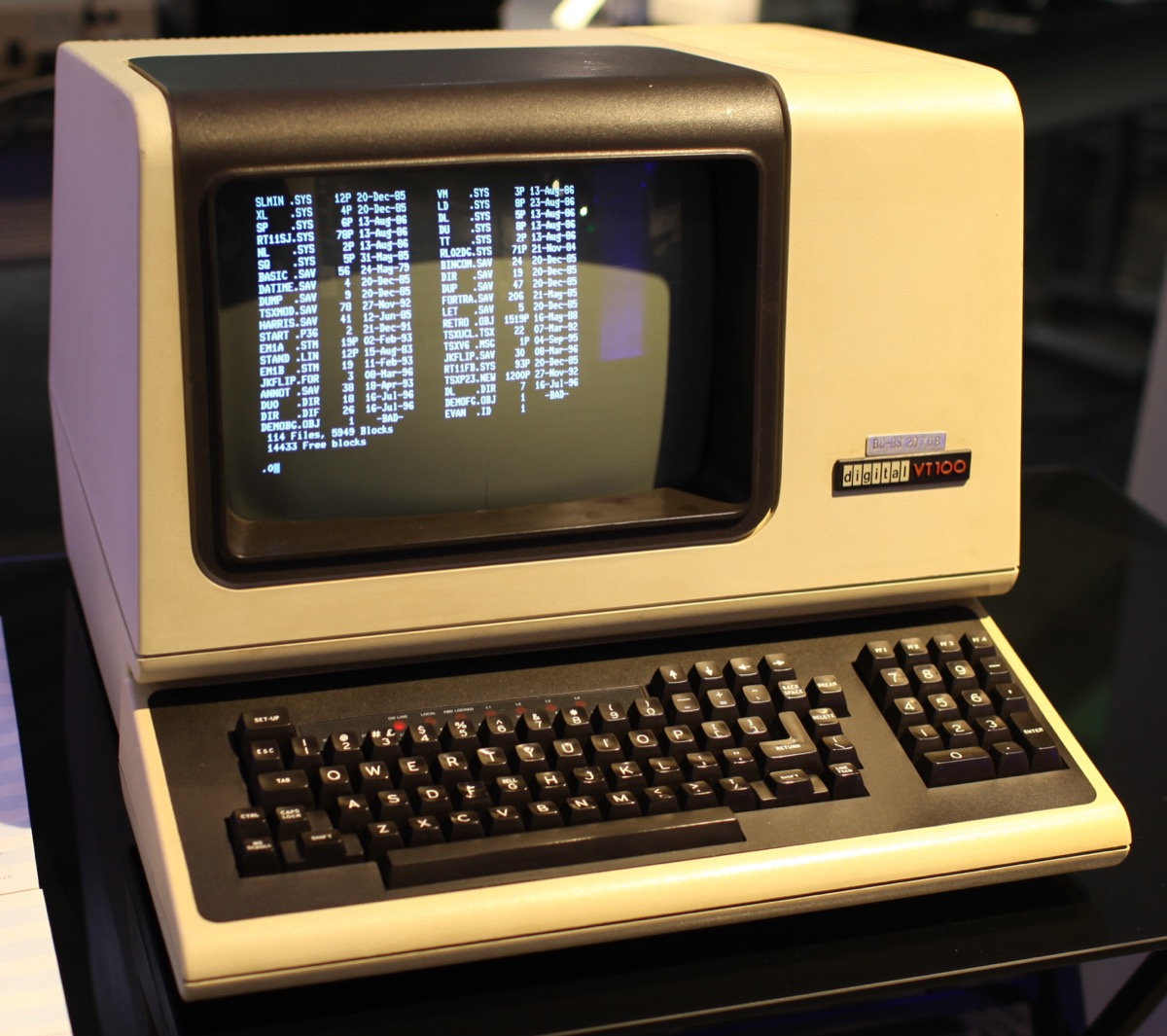
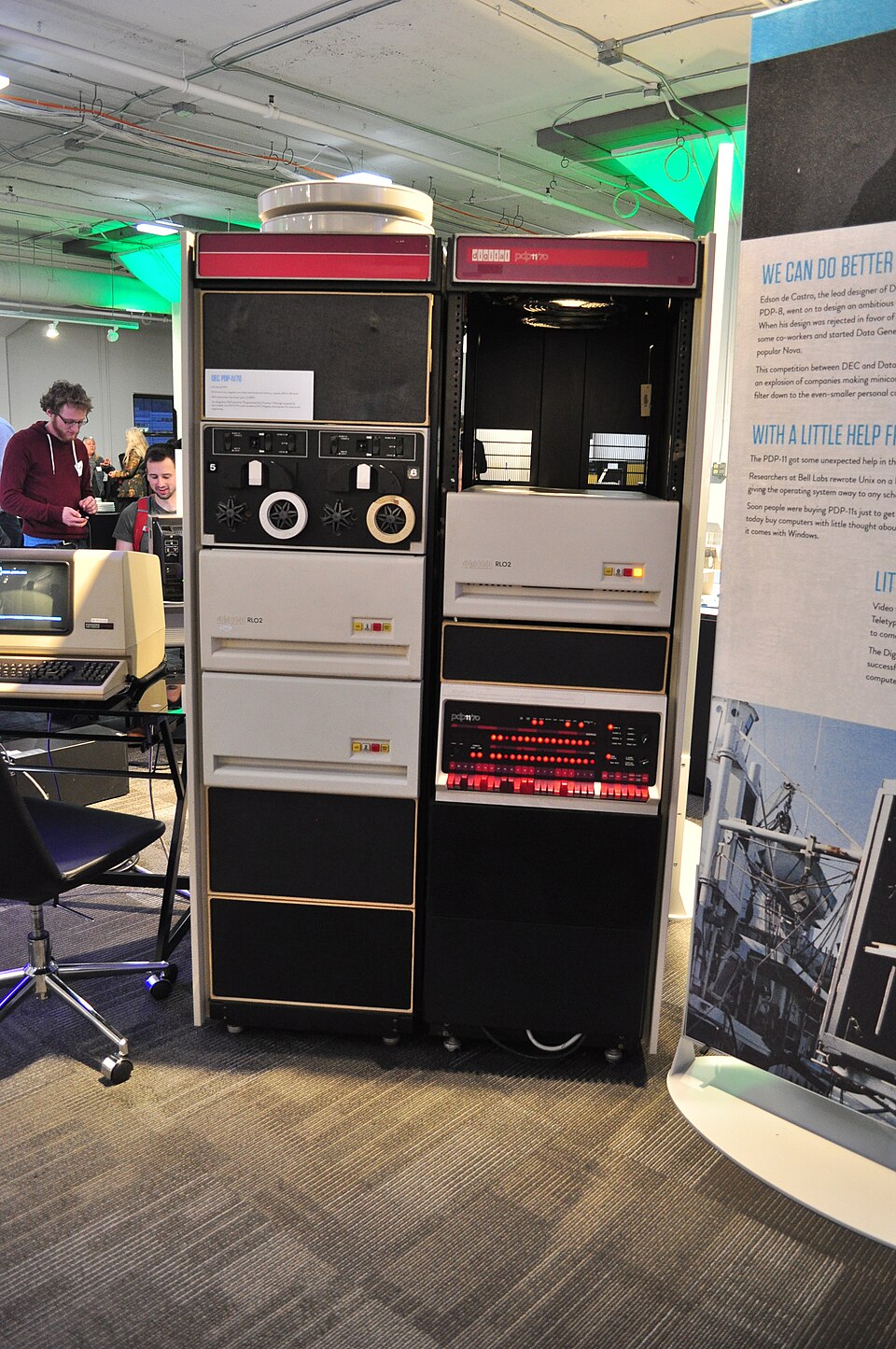
“Harold pulled out another design from his notebook — it was basically a design that he and I had worked on while he was a student at Carnegie.”Gordon Bell — VP of Engineering, DEC — on the birth of the PDP-11
16-bit architecture with a mostly orthogonal instruction set. 8 general-purpose registers: R0–R5, R6 (Stack Pointer), and R7 (Program Counter). Microcoded from the 11/45 onward; the 11/20 used discrete TTL logic. The original non-microprogrammed CPU was designed by Jim O'Loughlin.
8 addressing modes: Register, Register Deferred, Autoincrement, Autoincrement Deferred, Autodecrement, Autodecrement Deferred, Index, and Index Deferred. Each mode applicable to both source and destination operands independently.
From 56 KB (28 KW) on the 11/20 up to 4 MB with the 22-bit MMU on the 11/70. The 11/70 featured 2 KB of bipolar cache; the 11/44 expanded this to 8 KB. Core memory in early models; MOS RAM in later systems.
18 address lines (256 KB addressable), 16 data lines, 56 signal lines total on 72 physical bus lines. Memory-mapped I/O: every peripheral is accessed through the same address space as memory. No dedicated I/O instructions needed.
Optional FP11 processor from the PDP-11/45 onward. Supported 32-bit and 64-bit floating-point formats with a hidden-bit mantissa convention. This format was a direct predecessor to the IEEE 754 standard that governs all modern floating-point arithmetic.
Vectorized interrupts with 8 processor priority levels (0–7) encoded in the Processor Status Word. Four hardware bus request lines (BR4–BR7) with daisy-chain bus grant arbitration. Each device has its own interrupt vector in low memory.
The PDP-11's revolutionary concept: a single bus that unifies processor, memory, and peripherals in a coherent address space. Every component is a first-class citizen on the UNIBUS. No dedicated I/O instructions — a simple MOV to a device register address controls any peripheral.
16-bit Processor
R0-R5, SP (R6), PC (R7)
Floating Point
32/64-bit Formats
Memory Management
18 or 22-bit Address
2 KB Bipolar (11/70)
8 KB (11/44)
18-bit Address — 16-bit Data — 56 Signal Lines — Unified Memory & I/O — Master/Slave — DMA Capable
Core / MOS RAM
Up to 4 MB (22-bit)
RK05 / RL02
RP06 via MASSBUS
DL11 / DZ11
RS-232 Terminals
TU16 / TS11
800/1600 BPI
The PDP-11 processor evolved from cabinets of discrete transistor-transistor logic to single-chip VLSI microprocessors over two decades, a journey that mirrored the semiconductor revolution itself.
Discrete TTL logic, the only PDP-11 without microcode. Designed by Jim O'Loughlin. Fast ROMs were not yet economical for microcode storage.
First microcoded PDP-11 CPU, built with SSI/MSI bipolar logic. Introduced Kernel/Supervisor/User modes and the FP11 floating-point option.
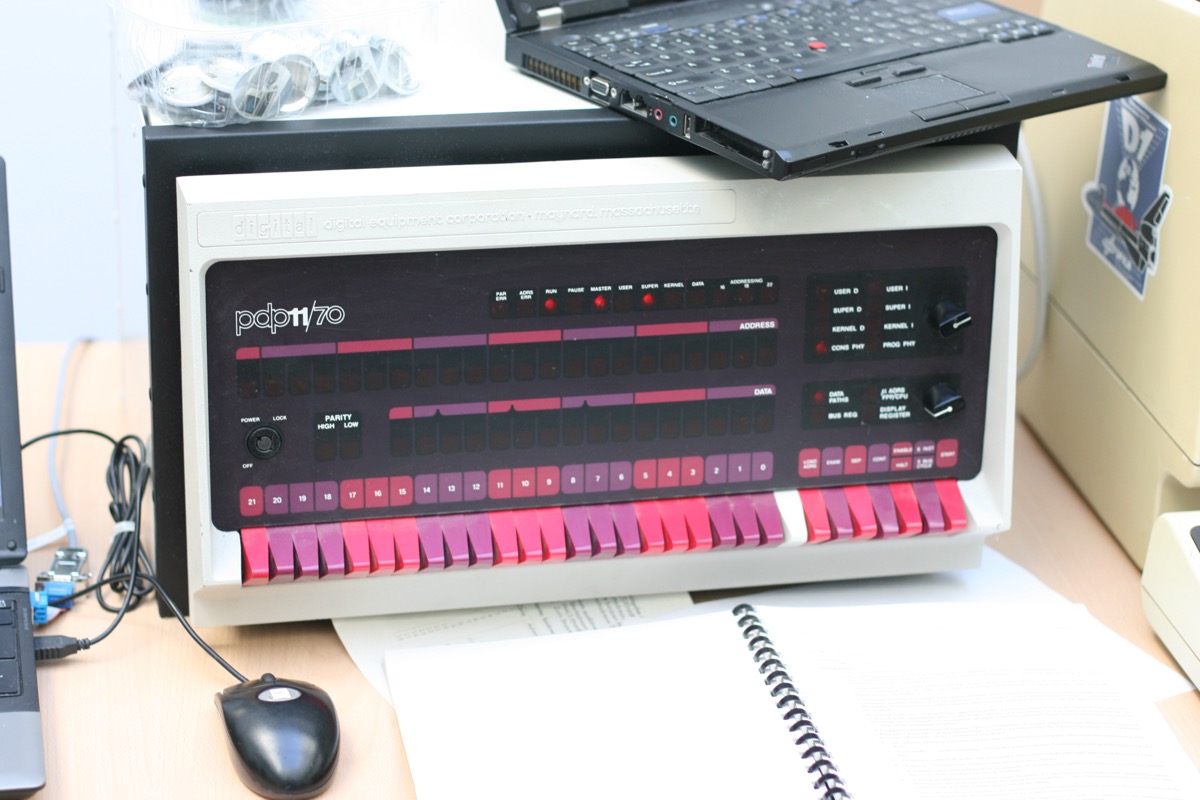
The flagship processor. Added 2 KB bipolar cache, 22-bit MMU for 4 MB physical memory, and separate MASSBUS path for high-speed disk I/O.
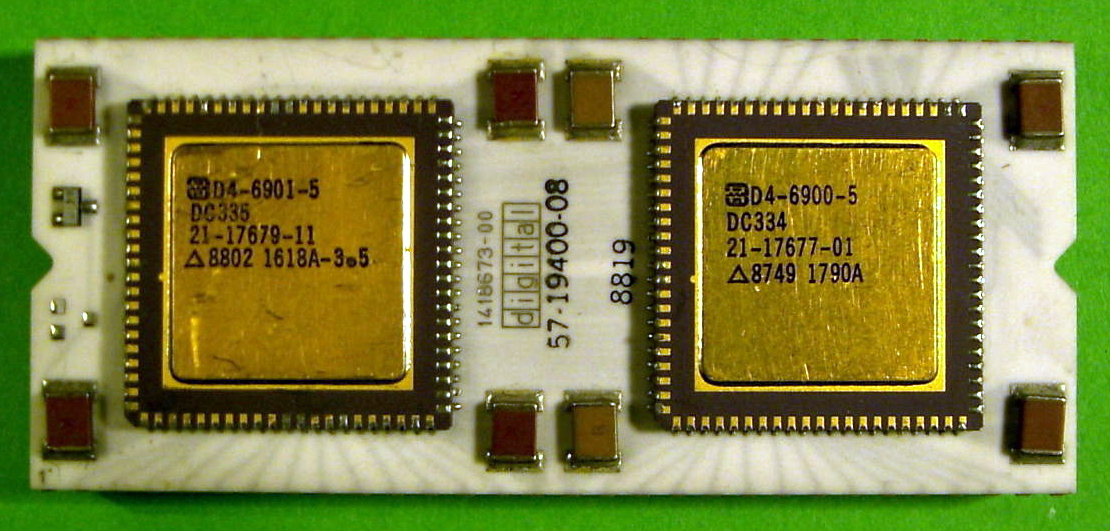
First LSI implementation: entire CPU on four chips by Western Digital. A data path chip, a control chip, and two microcode ROMs. Introduced the Q-Bus.
DEC's second LSI implementation. Data chip (DC302) and control chip (DC303). First VLSI PDP-11 for UNIBUS (11/24 via adapter). Designed at DEC.
DEC's fourth and last PDP-11 microprocessor, co-developed with Intersil. First PDP-11 CPU in CMOS technology. At 18 MHz, achieved 1 VUPS—the fastest PDP-11 ever.
Single-chip PDP-11 (DC310) for embedded and OEM applications. Reduced instruction set (no EIS, no FPU). Targeted at controllers, instruments, and terminals.
Actual PDP-11 assembly (MACRO-11 syntax) and C code from the era. The PDP-11's clean architecture made it a pleasure to program, and its power made it the ideal platform for developing the C language.
; PDP-11 MACRO-11 Assembly
; Print string to console terminal

        .TITLE  HELLO
        .MCALL  .TTYOUT,.EXIT
START:  MOV    #MSG,R1
LOOP:   MOVB   (R1)+,R0
        BEQ    DONE
        .TTYOUT
        BR     LOOP
DONE:   .EXIT

MSG:    .ASCIZ  /HELLO, PDP-11!/
        .EVEN
        .END   START
/*
 * UNIX Sixth Edition (V6)
 * /etc/glob.c - pathname expansion
 * Bell Laboratories, 1975
 * Ran on PDP-11/45 and PDP-11/70
 */

#define E2BIG   7
#define ENOEXEC 8

char    ab[512];
char    *atea, *ateb;
int     ncoll;

int
main(argc, argv)
int argc;
char *argv[];
{
    if(argc < 3) {
        write(2, "Arg count\n", 10);
        return(1);
    }
}
Thompson and Ritchie ported UNIX from the PDP-7 to the PDP-11 in assembly in 1970–71. In 1973, Version 4 UNIX was rewritten in C — the first OS written in a high-level language. UNIX on the PDP-11 spawned the ecosystem that produced Linux, macOS, Android, and most Internet infrastructure.
Dennis Ritchie developed C between 1969 and 1973, evolving it from the B language (itself derived from BCPL). C matured on the PDP-11/45 and /70. The PDP-11's byte-addressable memory and rich addressing modes influenced C's pointer arithmetic and data types. C went on to become the most influential programming language in history.
Dave Cutler led DEC's RSX-11M project from 1971 to 1976. Key design principles from RSX-11M reappeared in VAX/VMS, which Cutler also architected. In October 1988, Cutler left DEC for Microsoft, where he applied those same principles to build Windows NT (released 1993) — a direct architectural lineage from the PDP-11 era.
No other minicomputer supported such a rich ecosystem of operating systems. From single-user real-time executives to multi-user timesharing systems, the PDP-11 ran them all.
A small, efficient single-user real-time OS. Foreground/background scheduling allowed one real-time and one background task. Fit in 4 KW of memory. Popular for laboratory control and data acquisition.
Resource Sharing Executive for medium systems. Preemptive priority-based multitasking with up to 63 concurrent tasks. Required only 32 KW. Its design principles directly influenced VMS and later Windows NT.
Extended RSX-11M with support for larger memory (up to 4 MB with I/D space), improved file system, and multiprocessor support. Originally designed for the never-released PDP-11/74 dual-processor system.
The large real-time multiprogramming system for PDP-11/45 and 11/70. Supported multiple users, real-time tasks, and full memory management. Predecessor of RSX-11M.
Resource Sharing Time Sharing Extended. The primary timesharing system for PDP-11, supporting BASIC-PLUS as its native language. Popular in education and business, supporting up to 63 simultaneous users.
The first PDP-11 disk operating system. A batch-oriented system initially released for the PDP-11/20. Later superseded by RT-11 and RSX-11 for most applications.
A timesharing-oriented variant of RSX-11D, designed for the PDP-11/70. Optimized for interactive use with advanced scheduling algorithms and virtual memory support.
UNIX Versions 5, 6, and 7 all ran on PDP-11. The 2BSD distribution from UC Berkeley (1978–79) added the vi editor, C shell, and virtual memory. The last release, 2.11BSD (1991), is still maintained.
DEC's official UNIX implementation for PDP-11, based on 4.2BSD. Provided a supported UNIX environment for customers who needed vendor backing, bridging DEC's proprietary and open-source worlds.
A third-party timesharing add-on for RT-11 by S&H Computer Systems. Allowed up to 36 users to share a PDP-11 while maintaining full RT-11 program compatibility. Widely used in small businesses.
Massachusetts General Hospital Utility Multi-Programming System. A specialized OS and language for medical computing. DEC's DSM-11 implementation ran on PDP-11 and became dominant in healthcare IT worldwide.
A stripped-down RSX-11M-PLUS specifically for the MicroPDP-11 desktop systems. Brought full RSX-11 capabilities to the compact Q-Bus MicroPDP-11/23 and /73 form factors.
The PDP-11's orthogonal instruction set and clean architecture made it an ideal target for language compilers. DEC and third parties created an exceptionally rich software development environment.
The native assembly language. Powerful macro facilities, conditional assembly, and direct hardware access. Supported on all PDP-11 operating systems.
ANSI-66 FORTRAN compiler. Primary language for scientific and engineering computation on the PDP-11. Later upgraded to FORTRAN-77.
DEC's extended BASIC for RSTS/E, with virtual memory support. Could run interpreted or compiled (BASIC-PLUS-2). The native language of the RSTS timesharing system.
Developed by Dennis Ritchie at Bell Labs on the PDP-11/45 and /70. Matured as the implementation language for UNIX. Became the most influential programming language in history.
ANSI-74 COBOL for business data processing. Ran under RSX-11 and RSTS/E. Made the PDP-11 viable for commercial applications alongside scientific use.
Oregon Software Pascal and DEC Pascal for PDP-11. Popular in education and structured programming. Fully supported under RT-11 and RSX-11.
DEC's Digital Interactive Business Oriented Language. Designed specifically for business applications on PDP-11 systems, competing with COBOL in the minicomputer market.
DEC's systems programming language, developed at Carnegie Mellon. A structured, expression-based language used internally at DEC for system software development.
Kenneth Iverson's array-oriented language implemented for PDP-11. Used in financial modeling, actuarial work, and mathematical research.
A real-time programming language mandated by the UK Ministry of Defence. PDP-11 implementation was critical for British military and industrial control systems.
Text Editor and Corrector. Both a text editor and a Turing-complete programming language. TECO macros on the PDP-11 at MIT eventually evolved into GNU Emacs.
Both a language and a database system with built-in persistence. Native string handling and hierarchical data. Became the standard for medical information systems worldwide.
The PDP-11 wasn't just a lab machine. It controlled factories, ran phone networks, piloted military systems, and managed nuclear plants. Some remain in active service today.
PDP-11 systems running RSX-11M, RT-11, and RSTS control GE nuclear power plant robotics. As reported in 2013, these systems were expected to remain in operation until approximately 2050. Their core memory and TTL logic provide exceptional resilience to harsh environments.
The U.S. Navy used a PDP-11/34 to control its Multi-station Spatial Disorientation Device, a flight simulator for pilot training. It remained in active service until 2007, when it was replaced by a PC-based PDP-11 emulator running the original software.
Bell System and other telephone carriers deployed PDP-11 systems extensively for switching control and network management throughout the 1970s and 1980s. The machine's real-time vectorized interrupt handling made it ideal for telecommunications infrastructure.
With UNIX freely distributed to academic institutions, the PDP-11 became the standard university computer. The first BSD (Berkeley Software Distribution) releases ran on PDP-11 systems (notably 2BSD), spawning an entire generation of computer scientists and the open-source movement.
Original manuals, handbooks, brochures, and technical documentation preserved and digitized. Click any card to access the original scanned documents.
Bell & McFarland's original paper, Spring Joint Computer Conference, 1970.
gordonbell.azurewebsites.net →The pre-release handbook documenting the architecture before the first shipment.
gordonbell.azurewebsites.net →Complete reference for the first PDP-11 model, including UNIBUS specification.
archive.org →Complete technical reference for the flagship model.
bitsavers.org →Technical reference for the popular mid-range system.
archive.org →Original vintage DEC advertisement for the PDP-11/04 and 11/34 systems.
archive.org →Complete catalog of all available systems, options, and peripherals.
archive.org →Quick-reference with instruction set, addressing modes, and octal opcodes.
archive.org →One of the earliest PDP-11 software manuals. Paper Tape BASIC.
bitsavers.org →The complete index of all PDP-11 documentation: manuals, schematics, handbooks.
bitsavers.org →The PDP-11's UNIBUS and Q-Bus connected an immense range of storage devices, terminals, and controllers. These peripherals defined the computing experience of an era.
Front-loading removable cartridge drive introduced in 1972. Each 14-inch cartridge held 2.5 MB. The signature clunk-whirr of the RK05 spinning up was the heartbeat of many PDP-11 installations.
Top-loading cartridge drives. The RL01 (1977) held 5.2 MB; the RL02 (1979) doubled capacity to 10.4 MB. The removable platter packs made them ideal for multi-user environments.
High-capacity top-loading disk packs for the 11/70. The RP06 held 176 MB—enormous for the era. Connected via MASSBUS for maximum throughput, bypassing UNIBUS bandwidth limits.
DEC's 8-inch floppy drives. RX01 (1975): single-sided single-density, 256 KB. RX02 (1978): double density, 512 KB. Used for program distribution, backups, and boot media on small systems.
DEC's proprietary tape format providing reliable, block-addressable storage. The TU56 dual-drive unit could store 184 KB per reel. Unlike standard magnetic tape, DECtape allowed random access to individual blocks.
Industry-standard half-inch magnetic tape drives for archival storage and data exchange. Supported 800 and 1600 BPI densities. Connected via MASSBUS on the 11/70 for high-speed streaming.
DEC's first standalone ANSI-style video terminal (1974). 24 lines by 80 columns. Replaced the Teletype as the primary PDP-11 user interface. Cursor addressing via escape sequences.
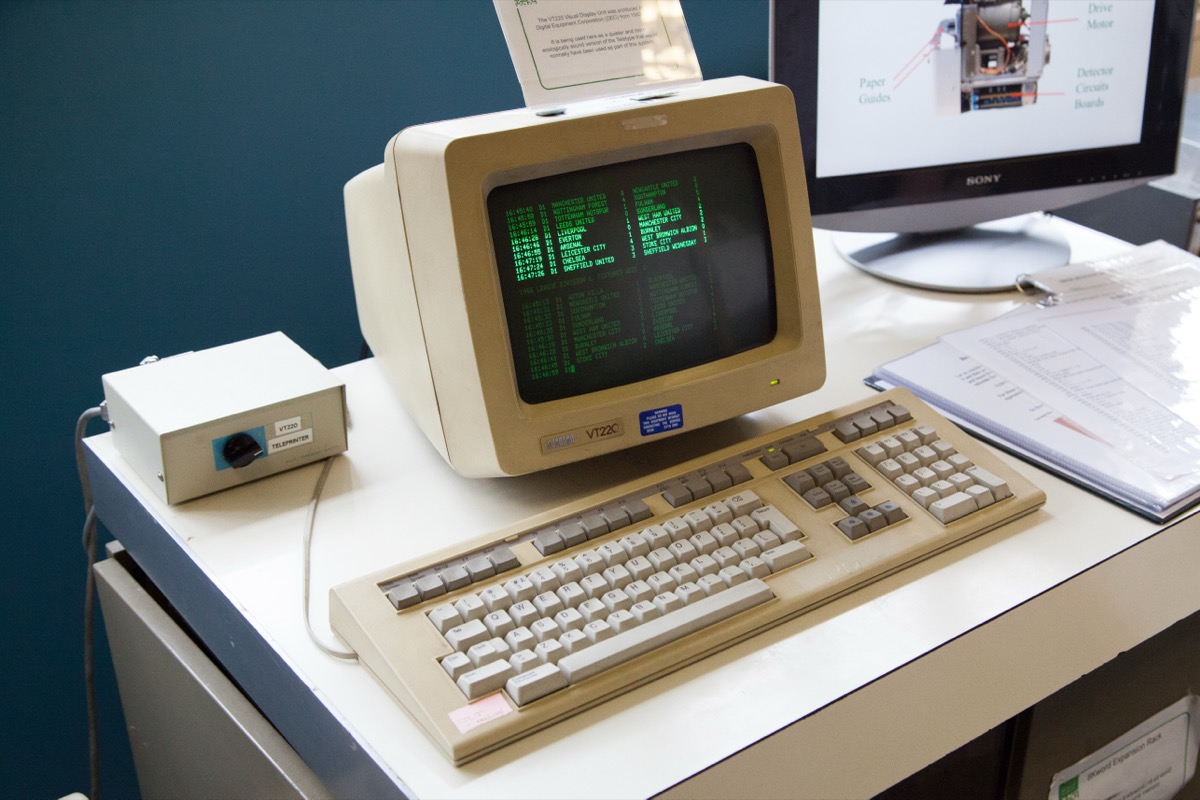
The legendary terminal (1978). ANSI X3.64 escape codes became the de facto standard still used today by every terminal emulator. Advanced Video Option provided double-width/height characters and smooth scrolling.
Third-generation DEC terminal (1983) with 8-bit character support, user-defined keys, and selectable character sets. Its amber phosphor glow became an iconic image of 1980s computing.
A dot-matrix printing terminal (1974) that served as both console and hardcopy output. 30 characters per second on continuous-feed paper. The standard console terminal for many PDP-11 installations.
| Bus | Introduced | Address Lines | Data Lines | Max Memory | Key Feature |
|---|---|---|---|---|---|
| UNIBUS | 1970 | 18 | 16 (separate) | 256 KB | Original unified bus, asynchronous, DMA capable |
| Q-Bus | 1975 | 22 | 16 (multiplexed) | 4 MB | Multiplexed addr/data, block transfers, lower cost |
| MASSBUS | 1975 | N/A | N/A | N/A | Dedicated high-speed disk/tape path, 11/70 only |
 The Soviet
The PDP-11 architecture was so influential that the Soviet Union produced an entire family of clones. In the early 1970s, factions within the USSR Ministry of Electronic Industry concluded that cloning proven Western architectures was strategically faster than developing original designs — a decision known in Russian computing literature as the “PDP revolt.” The 1801 series of binary-compatible processors, developed at the Angstrem plant in Zelenograd, were not photographic copies of DEC silicon but clean-room re-implementations of the PDP-11 instruction set. Despite the COCOM embargo that officially blocked Western technology transfers to the Eastern Bloc, the PDP-11’s publicly available technical documentation made the architecture an ideal cloning target. Over a million PDP-11-compatible machines were ultimately produced across the USSR and its allies.
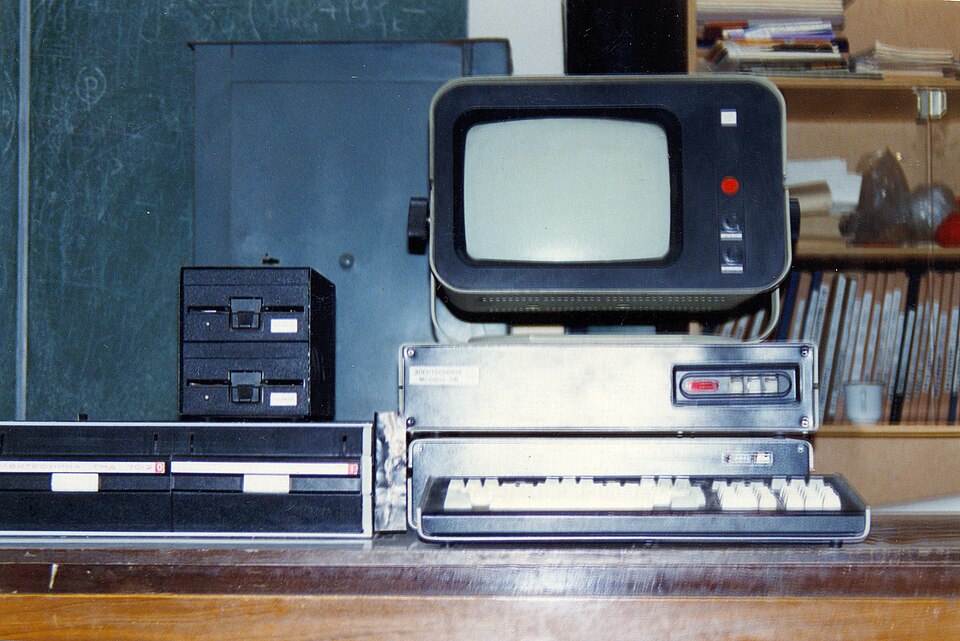
The machine that brought PDP-11 to the Soviet Union. Built in Voronezh, the Elektronika-60 was a rack-mounted clone of the DEC PDP-11/03 based on the 581 chipset (a Soviet reproduction of the Western Digital MCP-1600). Running RT-11 and its Soviet translations, it became the workhorse of laboratories and factories across the USSR from 1978 to 1991 — one of the longest production runs of any Soviet computer.
Its most famous legacy: in June 1984, Alexey Pajitnov wrote the original Tetris on an Elektronika-60. Because the machine had no graphics capability, the falling blocks were drawn with text characters — spaces and brackets. The entire game occupied only 2.7 KB.
PDP-11/03 Clone250K ops/secBirthplace of Tetris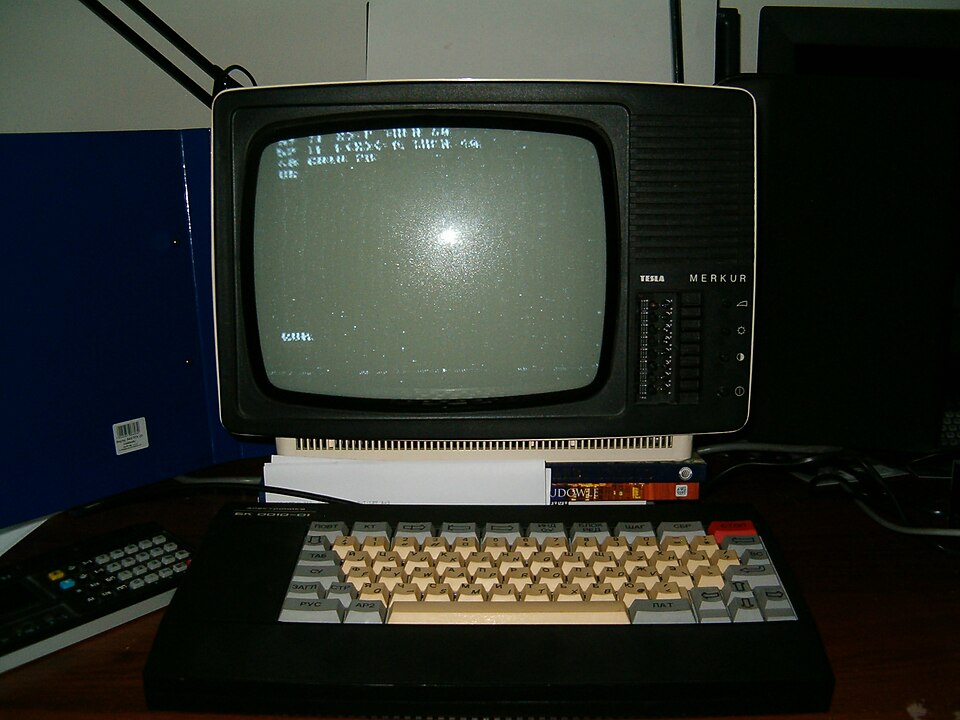
The only officially government-approved Soviet home computer in mass production. Built at the Zelenograd semiconductor complex around the K1801VM1 CPU at 3 MHz, it offered 32 KB RAM (half reserved for video memory) and 512×256 monochrome or 256×256 4-color graphics. At 600–650 roubles — roughly four months’ average salary — it was expensive but widely coveted.
The BK-0011M (1989) upgraded to 4 MHz and 128 KB paged RAM. Over 60,000 units were deployed in Soviet schools under the KUVT-86 program (1986–88), and the machines even served as cash registers in Moscow’s famous GUM department store.
K1801VM1 • 3 MHz32 KB RAM60K+ school units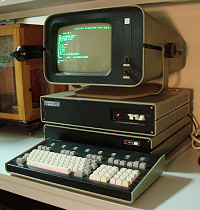
Professional PDP-11-compatible desktop systems developed at NIITT in Zelenograd, the same institute behind the BK series. Nine models spanned three CPU generations: the DVK-1/2 used the K1801VM1, the DVK-2M/3 stepped up to the K1801VM2 with full EIS instructions, and the DVK-3M/4 featured the K1801VM3 with 22-bit addressing (4 MB, equivalent to a PDP-11/73).
Widely used in scientific research, engineering, and industry, the DVK series reached approximately 200,000 units produced across nine models by 1990. They ran RT-11, RSX-11, and Soviet UNIX clones (DEMOS, MNOS).
~200,000 produced9 modelsLSI-11 to PDP-11/73 class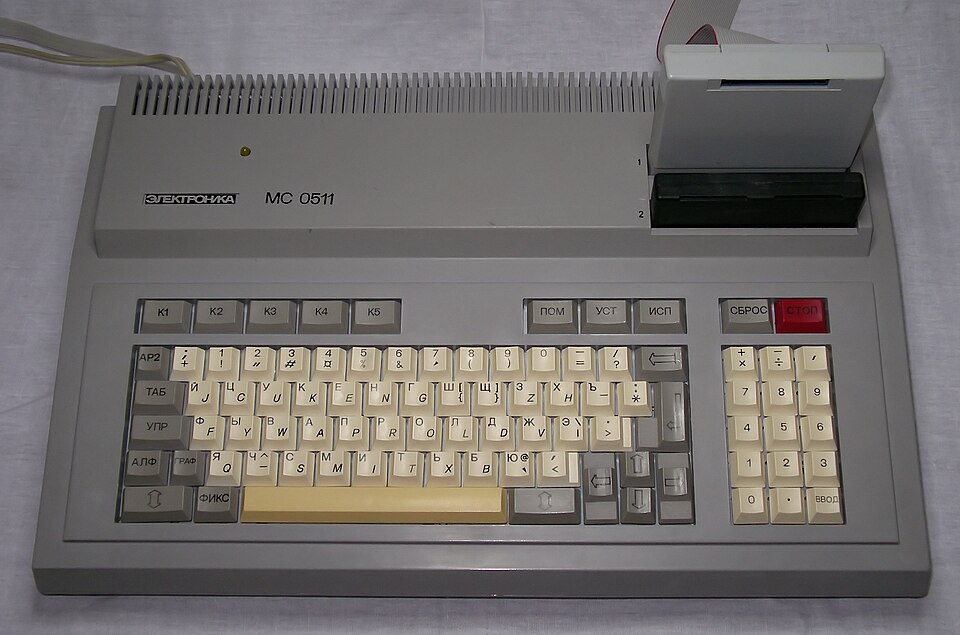
A dual-processor educational computer with a unique architecture: two separate K1801VM2 CPUs working in tandem. The central processor (8 MHz) ran user programs while the peripheral processor (6.25 MHz) managed all I/O, display, and keyboard — ensuring the main CPU was never interrupted by peripheral operations. With 192 KB total RAM and 640×288 8-color graphics, it was the most capable Soviet school computer of its era.
Approximately 310,000 units were manufactured at five factories across Russia, Lithuania, Georgia, and Moldova. The physical design was modeled on the Yamaha MSX form factor, but with a far more powerful PDP-11 architecture inside. It supported BASIC, Pascal, Fortran, C, Logo, Prolog, and Forth.
Dual K1801VM2~310,000 units5 factories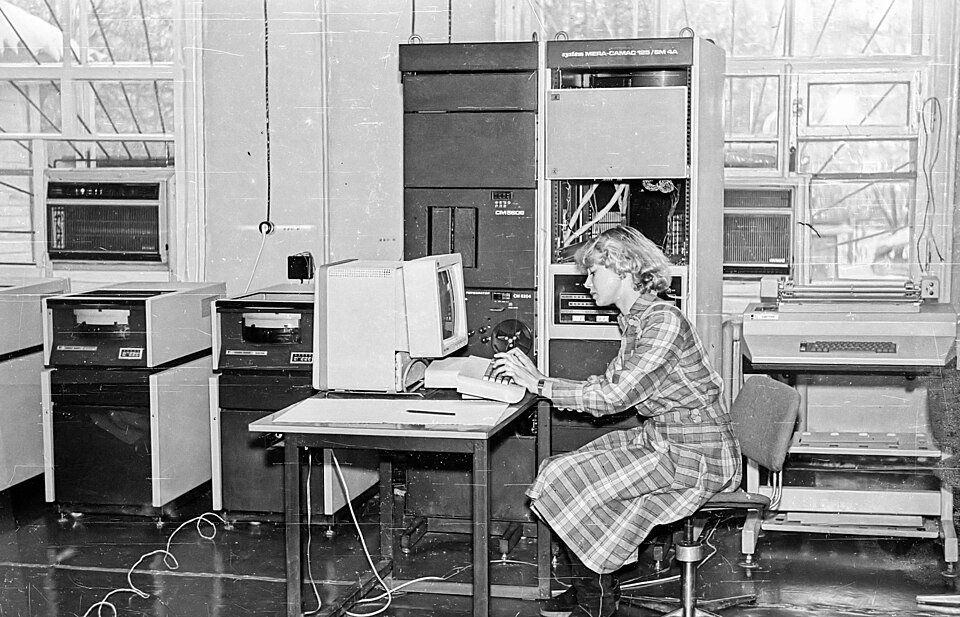
Full-scale PDP-11 minicomputer clones built under the SM EVM (System of Mini Computers) program — a Comecon-wide initiative launched in 1974 involving the USSR, Bulgaria, Hungary, East Germany, Cuba, Poland, Romania, and Czechoslovakia. The SM-4, produced primarily in Kyiv, cloned the PDP-11/40 with 128–256 KB ferrite core memory and 900,000 ops/sec. The SM-1420 (1983) succeeded it as a PDP-11/45 class machine with MOS memory.
Over 17,000 SM-series minicomputers were produced alongside 30,000+ SM-1800 variants. They ran translated RSX-11 and RT-11 operating systems and were the backbone of Soviet industrial automation, scientific research, and military computing throughout the 1980s.
PDP-11/40 & 11/45 clonesComecon-wide17,000+ minis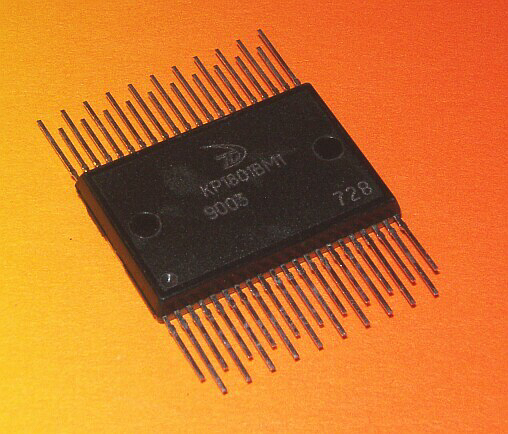
The silicon heart of the Soviet PDP-11 ecosystem. The K1801VM1 (1982, 5 μm nMOS, 16,646 transistors, up to 5 MHz) implemented the LSI-11 instruction set. The K1801VM2 (4 μm, 18,500 transistors, 10 MHz) added full EIS and floating-point via microcode. The K1801VM3 (4–3 μm, 28,900 transistors, up to 8 MHz) introduced 22-bit addressing for 4 MB physical memory — PDP-11/73 equivalent.
Later generations moved to CMOS: the 1806 series (5–16 MHz) and the final 1836 series reached 25 MHz. The separate 1811 series (Voronezh) cloned the F-11 chipset, and the 1831 series cloned the J-11 — completing Soviet coverage of the entire PDP-11 processor family.
5 μm to CMOSUp to 25 MHzFull PDP-11 familySoviet UNIX clones for PDP-11-compatible hardware, created at the Kurchatov Institute of Atomic Energy. DEMOS (“Dialogovaya Edinaya Mobilnaya Operatsionnaya Sistema”) was based on 2.9BSD and included Russian-translated utilities and documentation using the KOI-8 character encoding. MNOS, an earlier parallel effort, cloned Version 6 UNIX.
The two systems were gradually merged (1986–90) into DEMOS 2.x with unified Cyrillic support. DEMOS ran on an impressively wide range of hardware: SM-4, Elektronika-series machines, ES EVM (IBM 360/370 clones), and even VAX clones. The DEMOS team later pivoted to create RELCOM, the first Soviet internet network (1990).
Based on 2.9BSDKOI-8 CyrillicLed to RELCOM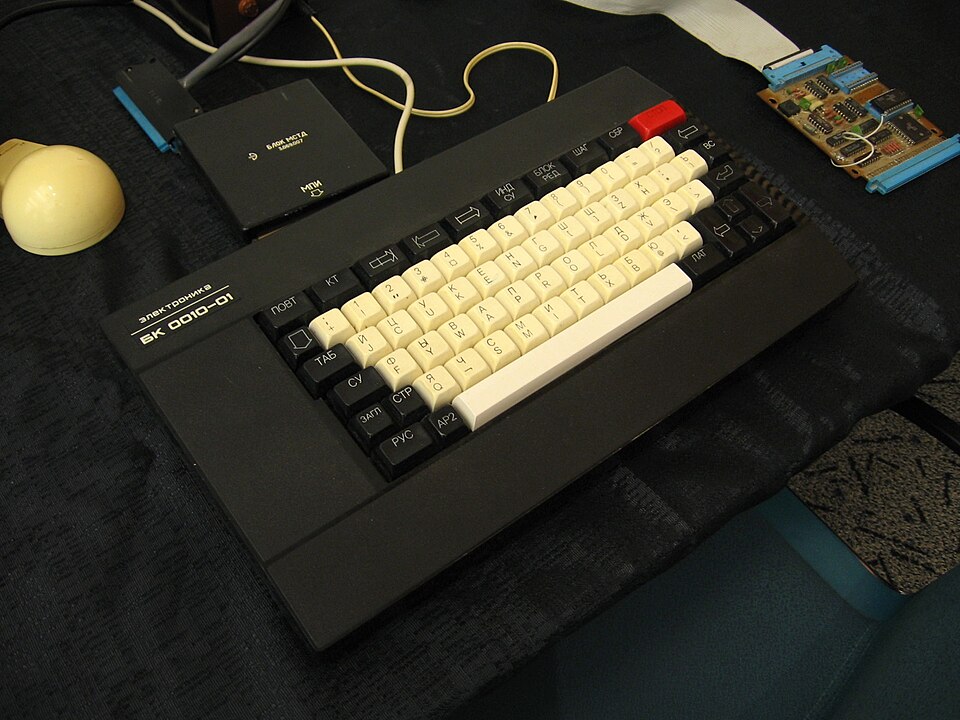
Perhaps the most improbable PDP-11 clone: a pocket calculator. The MK-85, released in early 1986, was the first Soviet handheld PC. Its T234-2 CPU implemented a PDP-11-compatible 16-bit architecture in a device smaller than a paperback book, with 2 KB RAM and 8 KB ROM running BASIC. Calculating sin(3) took 3.5 seconds — but it was a genuine PDP-11 in your pocket.
Approximately 150,000 units were manufactured between 1986 and 2000 at the Angstrem factory, priced at 145 roubles. The MK-85 could even run Tetris — bringing the PDP-11 full circle from the Elektronika-60 where the game was born.
PDP-11 in your pocket~150,000 units145 roublesHalf a century after its debut, the PDP-11 thrives through emulators, replica hardware, and an active community of enthusiasts keeping the architecture alive.
The gold standard for historical computer simulation. Created by Bob Supnik, SIMH accurately emulates PDP-11/03 through PDP-11/94 with full peripheral support. Runs all PDP-11 operating systems. Open-source and actively maintained since the late 1990s.
simh.trailing-edge.comCreated by Oscar Vermeulen, the PiDP-11 is a two-thirds scale replica of the PDP-11/70 front panel. Real LED blinkenlights and toggle switches connected to a Raspberry Pi running SIMH. All original operating systems come pre-installed and ready to boot.
obsolescence.devJavaScript-based PDP-11 emulators bring the machine to any web browser. PCjs provides a full PDP-11/70 simulation with front panel graphics. The pdp11-js project lets you boot UNIX V6 directly in your browser—no installation required.
pcjs.orgA high-performance commercial PDP-11 emulator by D Bit. Used in production environments where legacy PDP-11 software must continue running on modern hardware. Supports real-time applications and hardware I/O interfaces for industrial migration.
dbit.comThe last BSD release for PDP-11, still actively maintained. Patch level 469+ (2020s) continues to receive bug fixes and security updates. A testament to the enduring viability of the PDP-11 software ecosystem decades after hardware production ended.
tuhs.orgActive communities on cctalk, classiccmp, pidp-11 Google Group, and Reddit's r/retrobattlestations keep the PDP-11 spirit alive. Members restore original hardware, write new software, and share knowledge across generations of enthusiasts.
pdp11.orgThe PDP-11's influence extends far beyond 1970s computing. Its architecture directly inspired the Motorola 68000 — the MACSS design team explicitly cited the PDP-11 and VAX as influences, borrowing its orthogonal design, autoincrement/autodecrement modes, and memory-mapped I/O. The Intel x86 family also drew on PDP-11 concepts.
The FP11 floating-point format, with its hidden-bit mantissa convention, was a direct predecessor of the IEEE 754 standard that governs all modern floating-point arithmetic. RSX-11M's design principles flowed through VMS into Windows NT via architect Dave Cutler. UNIX and C, both developed on the PDP-11, became the foundation of modern computing.
In 1994, DEC sold PDP-11 system-software rights to Mentec Inc. of Ireland, who continued producing LSI-11 based boards. Some PDP-11 systems remain in active service today in nuclear power plants and industrial control, a testament to the extraordinary reliability and robustness of this architecture.